Systems · Off-grid
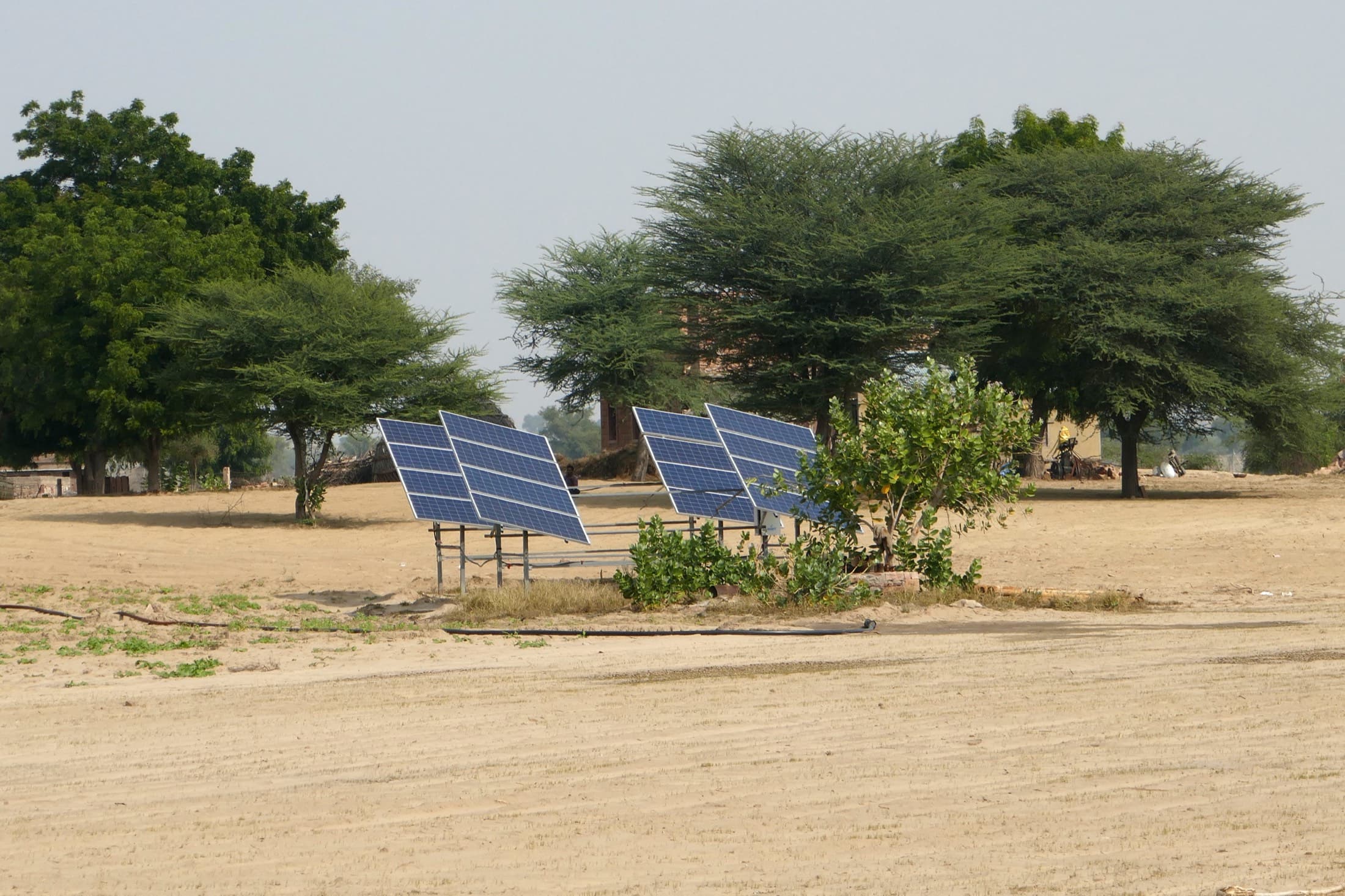
One of Rajasthan's larger off-grid fleets.
Hundreds of battery plants where power could not fail. That is where Suntask began, and why RMS watches batteries too.
370+
plants built and maintained across Rajasthan
Hundreds
of them battery-backed
RMS
battery telemetry on every one
Said first, on purpose
No PM Surya Ghar subsidy. Grid-connected homes should go on-grid.
Off-grid systems are not covered by the scheme, and a battery you do not need is the most expensive part of a system you should not buy. If your home has a working connection, the grid is your cheapest battery. Read on only if the grid cannot do the job at your site.
Read about on-gridWho genuinely needs it
Four kinds of site.
Weak-grid villages and dhanis
Where the feeder is down for hours a day and the voltage sags when it is up. The battery, not the line, runs the house.
Farms and pumps
Wells and drip lines far from a transformer, on a schedule that does not match agricultural supply hours.
Remote sites
Telecom towers, camps, resorts and outposts where a line would cost more than the plant.
Backup-critical premises
Clinics, cold rooms, petrol pumps and rural branches, where an hour without power costs more than a battery does.
Who does not
Have a grid connection? Start elsewhere.
Turning readers away from the wrong product is part of the job. These two pages are where most visitors to this one should be.
Grid-connected homes
On-grid costs least per kW, needs no battery, and is the only type the subsidy covers.
On-grid solarHomes that want backup
Keep the grid for net metering and add a battery sized to the loads you name. That is hybrid, and it costs less than going fully off-grid.
Hybrid solarNot sure?
Five questions, sixty seconds, and the form is tagged with the answer.
Which system fits?
Battery sizing, done properly
Rated kWh is not usable kWh.
Most off-grid plants that disappoint were sized from a brochure. Ours are sized from a load audit and four numbers we show you first.
- 01
Autonomy days
How many sunless days the bank must carry the site on its own. One to two for most Rajasthan homes; three for a clinic or a cold room.
- 02
Depth of discharge
Lead-acid is cycled to about half its capacity to last; lithium to 80 to 90%. We size on usable energy, not the number on the label.
- 03
Rajasthan heat derating
Battery life roughly halves for every 10°C above 25°C, a rule of thumb every battery maker publishes. We shade and ventilate the battery room and size for the summer it will live through.
- 04
The load audit
What actually must run, and for how long. We measure the site rather than take a list, because a fridge and a pump behave nothing like their nameplates.
RMS battery telemetry
RMS was built for this.
RMS began as the tool we used to watch hundreds of battery banks at sites we could not drive to every week. It still does that, for every plant we build.
Voltage and state of charge
Read every few minutes, so a bank that is not reaching full charge shows up in days, not at the first failure.
Alerts before a bank runs low
Threshold alerts to our service desk and to you, with the autonomy left in hours.
Charge and discharge history
The daily curve tells us whether the array, the controller or the battery is the weak link, before a technician leaves the office.
Battery
Rural branch · Barmer
Voltage
51.2V
Charge
78%
Load now
1.4kW
Autonomy left
43h
Last 24 hours · charge above the line, discharge below
On track
612 cycles · illustrative
Petrol pumps, clinics, telecom sites, rural branches: multi-site off-grid is our institutional desk.
Solar for institutionsOff-grid
Questions about off-grid.
Why is there no subsidy?
PM Surya Ghar subsidises grid-connected rooftop systems that export through a net meter. An off-grid plant has no meter to export through, so it falls outside the scheme. We say this before anything else because it changes the maths.
How long do the batteries last?
Lead-acid, cycled and cooled properly, three to five years. Lithium iron phosphate, eight to ten or more. In Rajasthan heat the difference widens, which is why we now specify lithium for most new sites.
Lithium or lead-acid?
Lithium costs roughly two to three times as much per kWh upfront and gives three to five times the cycle life, with more usable depth and less heat sensitivity. Over the life of the site it is usually cheaper. Current prices are quoted on WhatsApp.
Can it connect to the grid later?
Yes. When the line arrives, the plant becomes a hybrid: the battery stays, the inverter is swapped or reconfigured, and a net meter is applied for.
What happens on cloudy days?
The bank carries the site for the autonomy days it was sized for. Beyond that, a generator or load shedding takes over, and RMS warns you well before you get there.
Can a generator be part of it?
Yes, as the last resort. The controller starts it only when the bank is low, so it runs a fraction of the hours it used to and burns diesel only on the worst days.
Discuss my site
Tell us where the site is.
PIN code and bill band are enough to start. A Suntask engineer calls to plan the load audit and replies on WhatsApp within 15 minutes, 9am to 7pm.