The guide
The Rajasthan Rooftop Solar Guide.
2026 edition · checked September 2026
Eight short chapters to decide on solar, for homes, shops and factories. Read here, or get the PDF on WhatsApp.
Chapter 1
Is your roof right for solar?
Area, shade, direction and the sanctioned load decide it before any price does.
In short
- About 100 sq ft of clear roof per kW; 300 sq ft for the common 3 kW pack.
- Morning and evening shadows matter as much as noon.
- Plant size is capped at the sanctioned load on the bill.
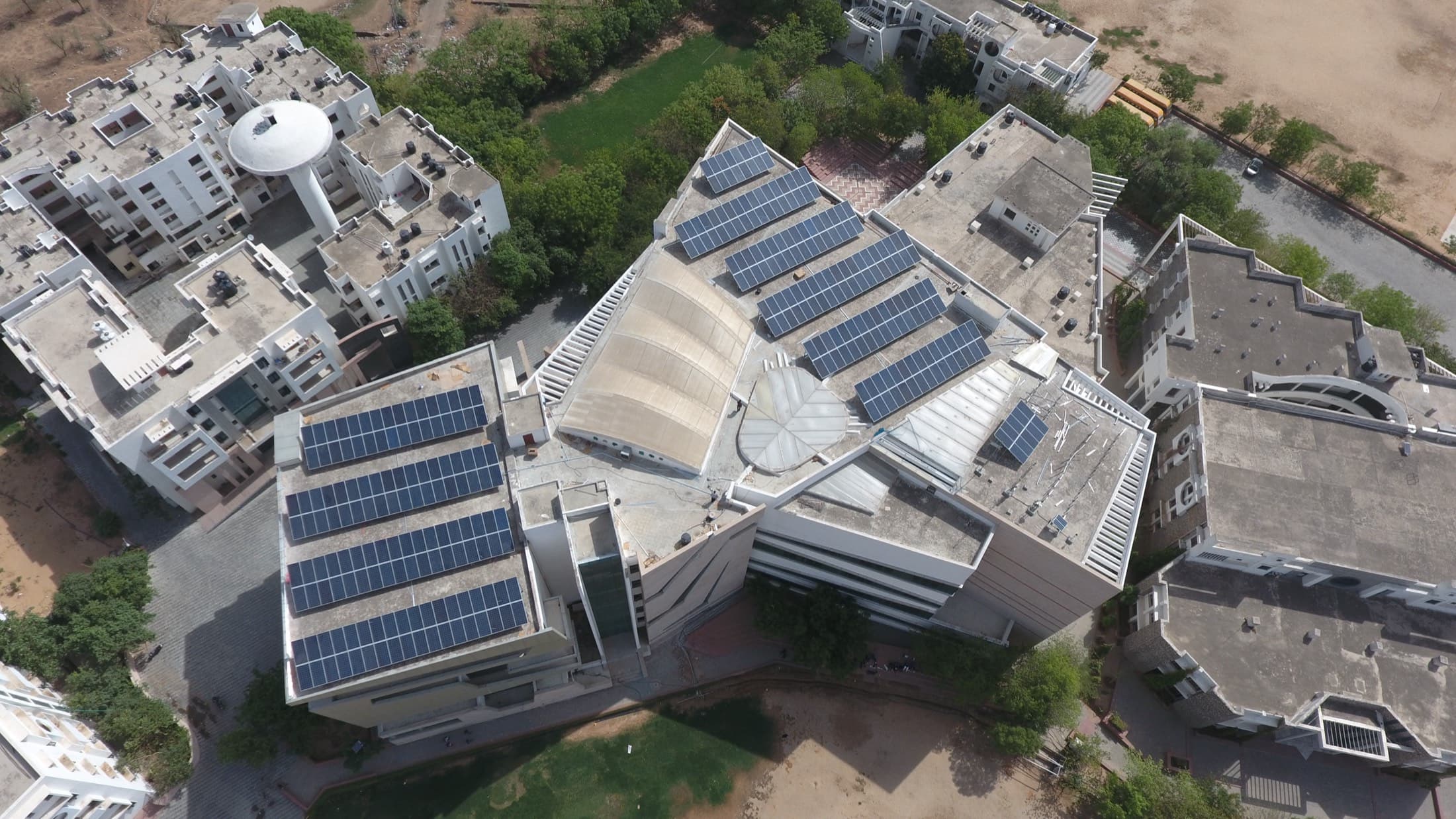
A rooftop plant needs about 100 square feet of unshaded roof per kilowatt, a south-facing or flat surface, and a wall near the meter for the inverter. Water tanks, parapets, a neighbour's taller building and a mobile tower all cast shadows that cost more units than most people expect, because a shaded module drags down every module in its string.
The other limit is on your electricity bill: the sanctioned load. Under net metering the plant cannot be bigger than that load, so a 5 kW plant on a 3 kW connection fails at feasibility. Raise the load with the DISCOM first, or size to it. On homes and shops, a Suntask engineer measures all of this at the survey and builds a 3D design of your roof within 30 minutes, so you see the panels, the shade and the cable run before you decide.
Chapter 2
Sizing: from your bill to kilowatts
Roughly 1 kW for every ₹800 to ₹1,000 of monthly bill, and about 1,475 units per kW a year.
In short
- 1 kW per ₹800 to ₹1,000 of monthly bill.
- 3 kW makes about 4,400 units a year in Rajasthan.
- Size to the summer bill, within the sanctioned load.
Rajasthan sun gives a well-sited roof about 1,475 units per kilowatt a year, the planning yield the calculator uses. Divide your yearly units by that and you have the plant size; in bill terms, roughly 1 kW for every ₹800 to ₹1,000 of monthly bill. A ₹3,000 bill usually means a 3 kW pack, which makes about 4,400 units a year, more in March to May and less in the monsoon.
Size to the summer bill if air conditioning drives it, and to the sanctioned load in any case. Going a little larger than today's use is sensible if an EV or a new AC is coming; going much larger only banks export the DISCOM settles at its own rate.
Chapter 3
The subsidy and the ₹17,000 top-up
₹78,000 from the centre at 3 kW and above, up to ₹17,000 more from the state for eligible families.
In short
- ₹30,000 per kW up to 2 kW, ₹18,000 for the third; ₹78,000 cap.
- Up to ₹17,000 more for MNBY families; ₹95,000 in all.
- Filed before install, by a registered vendor, with DCR panels.
PM Surya Ghar Muft Bijli Yojana pays ₹30,000 per kW for the first 2 kW and ₹18,000 for the third, capped at ₹78,000, by direct transfer into your own bank account after the plant is commissioned. Rajasthan adds up to ₹17,000 for connections under Mukhyamantri Nishulk Bijli Yojana, the 150-free-units scheme, taking the total to ₹95,000. The plant must be grid-connected, built by a vendor registered with your DISCOM, and use ALMM-listed panels with domestic cells.
You need Aadhaar with the name spelt as on the bill, the latest bill, proof of roof rights, a passport photo and an Aadhaar-seeded bank account. Most rejections come from a name mismatch, a wrong consumer number or an unseeded account, all fixable before filing. The last day to avail the subsidy is 31 March 2027, and the process takes weeks, so the practical deadline is earlier.
Chapter 4
Paying: ₹0 down, EMI, tax benefits
For most homes the subsidy covers the down payment and the savings cover the EMI.
In short
- About 7%, no collateral, up to ₹2 lakh for systems up to 3 kW.
- The subsidy prepays the loan; the EMI falls.
- Businesses: 5% GST as input credit, accelerated depreciation.
A collateral-free PM Surya Ghar loan at about 7% is available up to ₹2 lakh for systems up to 3 kW, through Rajasthan Gramin Bank and other banks on the Jan Samarth portal. The bank pays the vendor, you start on EMI, and when the subsidy lands it prepays part of the principal so the EMI drops. On a typical 3 kW home the EMI after the subsidy sits below the bill it replaces. If a bank loan does not suit you, the group's financing arm offers EMI on the same proposal.
Businesses take no subsidy and still pay back in three to five years: rooftop units at about ₹3 replace grid units at ₹6.50 to ₹8.50, the 5% GST on the installed plant comes back as input credit, and solar assets qualify for 40% accelerated depreciation with a further 20% in the first year for manufacturing units.
Chapter 5
Net metering with your DISCOM
A two-way meter, six steps at JVVNL, AVVNL or JdVVNL, and a bill that shows the net.
In short
- You pay for the net units, not the gross.
- Six DISCOM steps; we file and chase every one.
- Name mismatch, wrong consumer number and low sanctioned load are the usual stalls.
Net metering replaces your meter with a bidirectional one that counts import and export separately, and the DISCOM bills the difference. Daytime export is banked against evening import. The process runs application, feasibility, installation, work-completion report, inspection and meter, then the agreement and commissioning. Home subsidy cases apply through the national portal; shops, offices and factories apply through the DISCOM's own portal, free of the domestic-cell panel requirement.
Feasibility usually clears within a couple of weeks; the inspection and meter follow the completion report. Surplus export carries forward as credit and is settled at the end of the DISCOM's settlement period. A standard grid-tied plant switches off in a power cut for the safety of line workers; backup needs a hybrid system.
Go deeper
Chapter 6
Choosing the system: on-grid, hybrid or off-grid
On-grid for most; hybrid where cuts are long; off-grid only where there is no line.
In short
- On-grid: cheapest per unit, subsidy, least upkeep.
- Hybrid: backup for the essentials, still subsidised.
- Off-grid: no subsidy, for sites without a line.
An on-grid plant has no battery: it feeds the house and exports the rest under net metering, takes the subsidy, costs the least per unit and needs the least looking after. A hybrid plant adds a battery and a hybrid inverter so the essentials keep running through a cut; it still takes the subsidy, at a higher price and with a battery to care for. An off-grid plant stands alone, with no subsidy and no export, and belongs where there is no reliable line at all.
Most Rajasthan homes and shops are best served on-grid, and an on-grid plant can be given a battery later with a change of inverter. The five-question check on the Systems page gives you the answer with the reason, without asking for a phone number.
Chapter 7
Panels, inverters and the quote
ALMM and DCR decide the subsidy; a fair quote names every component.
In short
- ALMM List-I for every plant; DCR cells for the subsidy.
- Check the model on mnre.gov.in before you sign.
- Ten questions, one page: the checklist below.
Only modules on the government's ALMM List-I can be used in a subsidised plant, and PM Surya Ghar further requires DCR modules, whose cells are made in India. Shops, factories and give-up-subsidy homes are free to use any ALMM-listed module and often get more wattage for the money. The inverter should carry BIS certification and be set to your DISCOM's grid parameters.
A quote you can trust names the module make and model, the inverter, the structure and its wind rating, the cable size and the earthing, states whether the price is fixed after the survey, says who files the subsidy and net metering, and answers the question most installers cannot: what happens if generation drops.
Chapter 8
After install: dust, monitoring and service
Dust can take 15%; monitoring sees it first; service keeps it clean.
In short
- Clean to the dust season; plain water, soft brush, cool glass.
- RMS sees a 10% loss you cannot see from the ground.
- Five years of service included; renew from year six.
Rajasthan dust is the biggest controllable loss, up to 15% on an uncleaned array, so cleaning follows the dust season: every two to three weeks in the March to June dust, after the first rains, and monthly through the winter. Plain water and a soft brush in the cool of the morning; never a detergent, an abrasive or a hard jet on a hot panel. Heat trims output a little, but the long days more than compensate.
Every Suntask plant reports to RMS, our in-house monitoring platform, which records every unit every day and raises a ticket when generation drifts. Five years of service are included with every plant we build: cleaning to the dust season, inverter checks, and warranty claims raised and followed on your behalf. Renew yearly from year six, for up to 10 years.
Go deeper
The PDF
Get the guide on WhatsApp.
The same eight chapters as a PDF you can forward to the family or the plant head. Drop your WhatsApp number and you get it the day it is ready.
About the guide
Before you read on.
Is the guide free?
Yes, on this page and as a PDF. No email address, no login. The WhatsApp number is only so we can send the PDF.
How current are the figures?
Subsidy slabs, the top-up, loan terms and tariffs are checked against the scheme portals each quarter; the edition line at the top says when. The PM Surya Ghar and financing pages carry the same dates.
Does it apply outside Rajasthan?
The central subsidy and the ALMM rules do. The ₹17,000 top-up, the DISCOM steps, the yields and the tariffs are Rajasthan's, and so is Suntask.
I run a shop or a factory. Which chapters matter?
Chapters 1, 2, 4, 5, 7 and 8. Skip the subsidy chapter; the business levers are in chapter 4 and the factory post it links to.
Free bill audit
Get your roof's number.
Name, PIN and bill band. An engineer replies on WhatsApp within 15 minutes, 9am to 7pm, with a size, the subsidy and a savings figure from your own bill.